

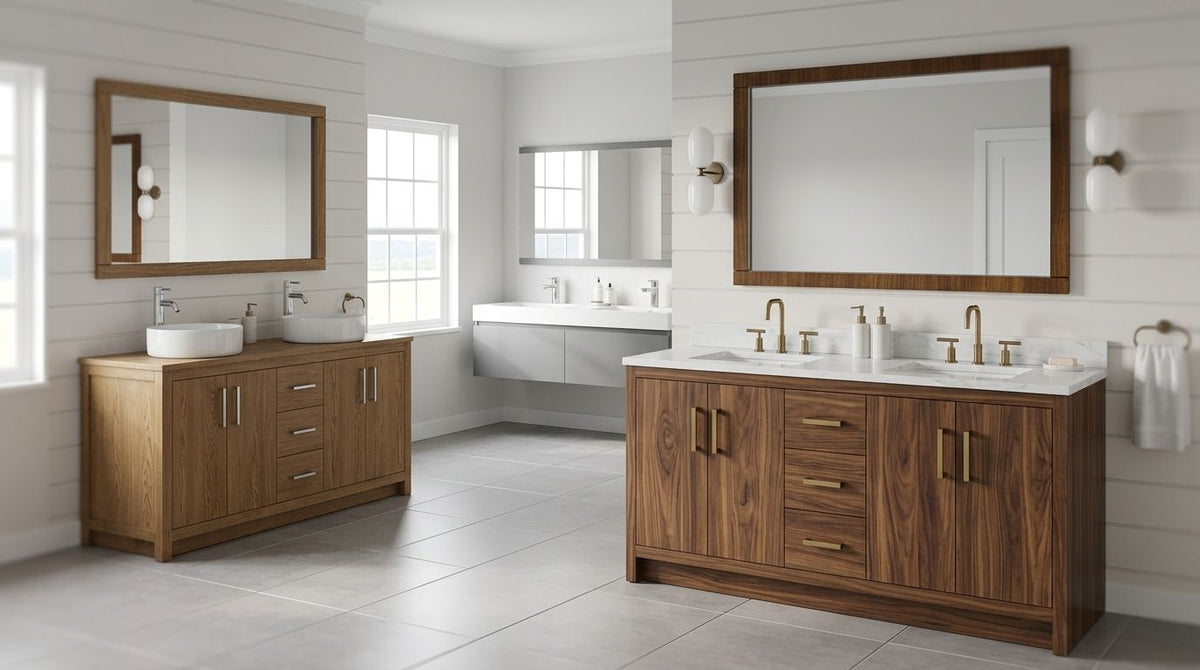
Best overall: the Graham 72-inch oak double-sink vanity from Eviva. Best for a shorter wall: the Artemis 44-inch oak double-sink vanity. Best budget option among these picks: the Lugano 48-inch rosewood double-sink vanity. This 2026 guide compares six double-sink vanities by width, basin design, top material and style.
- The best double sink vanities for most shared bathrooms include Eviva Graham 72-inch: two sinks and an oak finish.
- Artemis 44-inch is the compact pick; confirm that its two-basin layout leaves enough counter space for you.
- Choose Lugano 48-inch for a rosewood finish and an acrylic top with integrated sinks.
- Measure the wall and plumbing before choosing a 48-inch double vanity or a wider oak double vanity.
Why this matters
A double-sink vanity solves one problem: two people can use separate basins. It can create another if the cabinet takes up the wall space needed for doors, drawers or movement through the room. In 2026, choose the width that fits your bathroom before choosing a finish. A 44-inch cabinet and a 96-inch cabinet answer different space constraints, even when both have two sinks.
Eviva lists the Graham, Artemis, Lugano, Glazzy and Aberdeen models in this guide as double-sink vanities. Their stated widths, finishes and top materials give you a useful shortlist, but a product width alone does not establish that a vanity fits your room. Check the actual installation dimensions and the space around the cabinet before ordering.
What makes the best double sink vanities?
Use these criteria to assess any double-sink vanity in 2026:
- Width and clearance: Measure the available wall, then account for doors and the space you need to move past the vanity. Do not treat cabinet width as your only fit check.
- Sink layout: Two basins let two people wash up separately. On a narrower cabinet, inspect how much usable surface remains beside and between them.
- Top and basin: The Graham, Artemis and Aberdeen picks pair an Arabescato engineered stone top with undermount porcelain sinks. Lugano and Glazzy pair an acrylic top with integrated sinks. Choose the configuration you prefer rather than assuming the materials perform identically.
- Finish and style: Oak, rosewood and white lead to different room designs. Compare the finish against the surfaces already planned for your remodel.
- Installation fit: Confirm the listed dimensions and plumbing positions against your room. Do not assume that a new two-sink vanity matches an existing single-sink installation.
The 2026 shortlist starts with width because the wrong-sized vanity cannot become the right choice through a different top or finish.
Best double sink vanities at a glance
| Vanity | Best for | Standout feature | Key limitation |
|---|---|---|---|
| Graham 72-inch oak | Most shared bathrooms | Oak finish; engineered stone top and undermount porcelain sinks | Needs a wall that accommodates 72 inches |
| Artemis 44-inch oak | Shorter vanity walls | Two sinks in a 44-inch cabinet | Less width around the basins than wider picks |
| Lugano 48-inch rosewood | Rosewood styling | Acrylic top with integrated sinks | Rosewood finish will not suit every design |
| Glazzy 47-inch white | White integrated-sink styling | White finish and acrylic top | Not an undermount-sink choice |
| Aberdeen 84-inch oak | Traditional-modern styling | Traditional and modern design elements | Requires space for an 84-inch cabinet |
| Graham 96-inch oak | Long vanity walls | Two sinks across a 96-inch cabinet | Excessive width for a shorter wall |
Start with the row that fits your measured wall, then compare the top and finish. The table describes the listed models; it does not replace a check of full product dimensions or your plumbing layout.


The picks, by room and style
1. Graham 72-inch oak: best double-sink vanity for a shared bathroom
The Graham 72-inch is the default pick for a bathroom with room for a longer vanity. It has an oak finish, an Arabescato engineered stone top and two undermount porcelain sinks. Eviva Graham 72-inch is best for homeowners who want two separate basins without choosing the widest cabinet in this guide.
Graham 72-inch pros:
- Two sinks provide separate washing positions.
- Oak offers an alternative to the white and rosewood picks.
- The undermount porcelain sinks distinguish it from the integrated-sink options.
Graham 72-inch cons:
- A 72-inch cabinet is unsuitable when the measured wall is shorter.
- Choose another model if you specifically want an acrylic top with integrated sinks.
Best for: A shared bathroom with space for a 72-inch vanity. Verdict: Buy if the full dimensions and plumbing layout fit.
2. Artemis 44-inch oak: best for a shorter vanity wall
The Artemis 44-inch puts two undermount porcelain sinks beneath an Arabescato engineered stone top. Its oak finish gives you a compact alternative to the wider Graham models. That shorter width is its reason to be here, not a claim that every small bathroom can accommodate it.
Artemis 44-inch pros:
- It is the narrowest double-sink model in this shortlist.
- Two basins serve separate users.
- It has the engineered stone and undermount-porcelain combination offered by several wider picks.
Artemis 44-inch cons:
- Its overall width leaves less room to distribute between two sinks than a wider cabinet does.
- It is not a white-finish or integrated-sink option.
Best for: A wall that accommodates 44 inches but not the wider picks. Verdict: Buy after checking basin spacing against how you use the counter.
3. Lugano 48-inch rosewood: best for a rosewood finish
The Lugano 48-inch pairs a rosewood finish with an acrylic top and integrated sinks. It is the budget pick among the six listed models, but the better reason to choose it is the combination of its finish, width and sink design. Compare that design directly with the 48-inch Graham if you are deciding between integrated and undermount sinks.
Lugano 48-inch pros:
- The rosewood finish is distinct from the oak and white picks.
- Integrated sinks give you a different basin design from the porcelain-undermount models.
- Its 48-inch width gives you a middle option between Artemis and Graham 72-inch.
Lugano 48-inch cons:
- Skip it if your design calls for an engineered stone top.
- Its rosewood finish is less suitable for a room planned around a white vanity.
Best for: A remodeler seeking a rosewood, integrated-sink vanity. Verdict: Buy if that combination matches your plan.
4. Glazzy 47-inch white: best for white integrated-sink styling
The Glazzy 47-inch has a white finish, an acrylic top and integrated sinks. It offers a different visual direction from the oak and rosewood models without requiring a long vanity wall. Compare its full measurements with your room rather than assuming a one-inch difference from a 48-inch pick settles the fit.
Glazzy 47-inch pros:
- White offers an alternative to wood-look finishes.
- Its integrated sinks distinguish it from the undermount-porcelain picks.
- At 47 inches wide, it is shorter than the 72-, 84- and 96-inch options.
Glazzy 47-inch cons:
- It does not offer the listed engineered-stone-and-porcelain combination.
- Its white finish is the wrong choice if oak or rosewood is central to your design.
Best for: A bathroom plan built around a white vanity and integrated sinks. Verdict: Buy if its full dimensions fit.
5. Aberdeen 84-inch oak: best for traditional-modern styling
The Aberdeen 84-inch combines traditional and modern design elements in an oak double-sink vanity. Its Arabescato engineered stone top and undermount porcelain sinks match the material pairing of the Graham and Artemis picks. Choose it for the design direction only after establishing that your room can take its width.
Aberdeen 84-inch pros:
- Its design mixes traditional and modern elements.
- Two undermount porcelain sinks provide separate basin positions.
- The oak finish differs from the white and rosewood choices.
Aberdeen 84-inch cons:
- An 84-inch width rules it out for shorter vanity walls.
- It is not the pick for integrated sinks or a white finish.
Best for: A larger bathroom where traditional-modern styling is the priority. Verdict: Buy if the cabinet and surrounding clearances work together.
6. Graham 96-inch oak: best for a long vanity wall
The Graham 96-inch extends the same stated oak, Arabescato engineered stone and undermount porcelain-sink combination to the widest model in this guide. Its advantage is width, not an assumption that a larger cabinet automatically works better. Check the complete installation plan before making a wide vanity the centerpiece of the room.
Graham 96-inch pros:
- It is the widest of these six double-sink options.
- The oak finish and engineered stone top suit buyers considering the Graham 72-inch.
- Two undermount porcelain sinks provide separate washing positions.
Graham 96-inch cons:
- A 96-inch cabinet is impractical for a shorter wall.
- Extra width does not solve poorly placed plumbing or blocked clearances.
Best for: A bathroom with a long, usable vanity wall. Verdict: Buy only when the measured space calls for this width; otherwise, choose a shorter model.
How these picks were ranked
The 2026 ranking gives the default slot to a middle-width, two-sink option, then assigns each remaining model a distinct fit or style need. Width, stated sink configuration, top material and finish determine the positions. It is a buying decision tree, not a claim that one finish or top material is universally better.
Which double-sink vanity should you choose?
Choose Eviva Graham 72-inch by default if your room fits it and you want oak, engineered stone and two undermount porcelain sinks. Pick Artemis 44-inch when a shorter wall is the constraint. Choose Lugano 48-inch or Glazzy 47-inch when an integrated-sink design matches your plan; move to Aberdeen 84-inch or Graham 96-inch only when the larger width serves your room.
For any 2026 bathroom remodel, confirm the full product measurements and plumbing positions before treating a listed cabinet width as a fit guarantee. That check matters more than moving a preferred finish to the top of your list.
FAQ
What are the best double sink vanities for most shared bathrooms in 2026?
Graham 72-inch is the default pick when your bathroom fits a 72-inch cabinet. It has two undermount porcelain sinks, an engineered stone top and an oak finish.
What is the narrowest double-sink vanity in this guide?
Artemis 44-inch is the narrowest of the six picks. Check the space around and between its basins before choosing it for a shared counter.
Is a 48-inch double-sink vanity suitable for my bathroom?
A 48-inch double-sink vanity is suitable when its full dimensions, surrounding clearances and plumbing positions fit your room. The listed width alone does not answer that question.
What is the difference between integrated and undermount sinks here?
Lugano and Glazzy are listed with acrylic tops and integrated sinks; Graham, Artemis and Aberdeen are listed with engineered stone tops and undermount porcelain sinks. Choose the stated configuration that matches your design plan.
Which pick has a white finish?
Glazzy 47-inch is the white double-sink pick in this guide. It pairs that finish with an acrylic top and integrated sinks.
Should I choose the 84-inch Aberdeen or the 96-inch Graham?
Choose Aberdeen 84-inch for its traditional-modern styling when that width fits. Choose Graham 96-inch when your room calls for a longer oak vanity with two undermount porcelain sinks.
How do I check whether a double-sink vanity fits?
Measure the intended wall and verify the vanity's full dimensions, nearby door clearances and plumbing positions. Do that before deciding on the finish or top material.
One last thing
The shortest double-sink pick here is 44 inches wide, yet it still has to accommodate two basins. In 2026, inspect the usable space beside and between the sinks before treating a compact double vanity as a substitute for a roomier one.
Share:
Best contemporary bathroom cabinets in 2026
Best espresso bathroom vanities in 2026