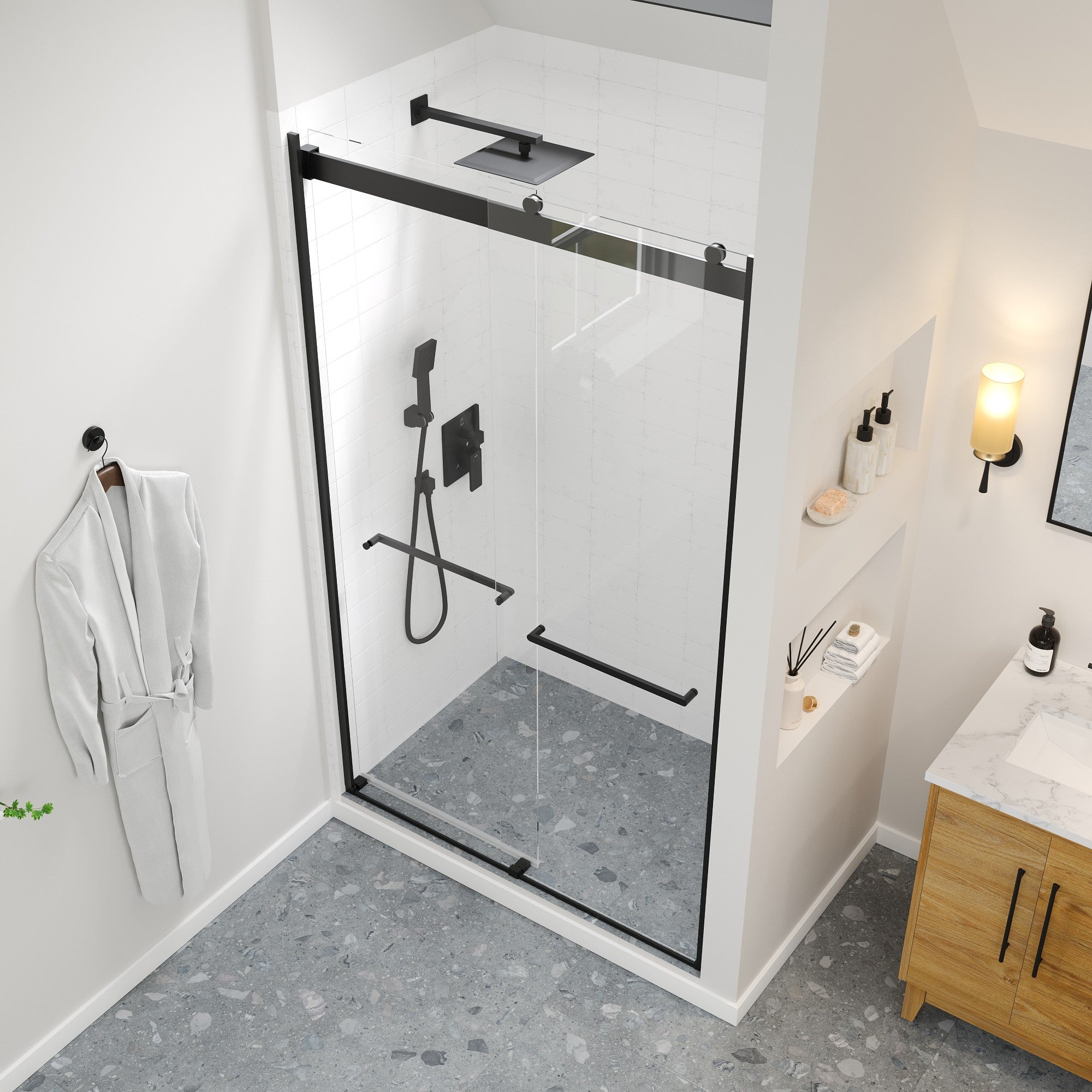
Frameless sliding shower doors do not inherently leak more than hinged doors; water containment depends on the enclosure's fit, seals, threshold, and exposure to spray. Sliding doors need correctly configured panel overlaps and bottom guides, while hinged doors need correctly fitted edge seals and bottom sweeps. Neither door style compensates for a threshold that sends water toward your bathroom floor.
- Do frameless sliding shower doors leak more than hinged doors? Not inherently; compare the complete enclosure, not just door movement.
- Sliding shower doors save swing space; hinged shower doors need clearance and correctly fitted perimeter seals.
- Eviva frameless sliding shower doors suit homeowners seeking a sliding layout; verify opening dimensions and installation requirements.
- Trace escaping water before replacing seals: spray direction, panel alignment, and threshold drainage need separate checks.
Do frameless sliding shower doors leak more than hinged doors?
Door movement alone does not establish which enclosure will leak more. Compare where water can escape and how each assembly directs it back into the shower.
| Detail | Frameless sliding door | Frameless hinged door |
|---|---|---|
| Best for | Bathrooms where an outward door swing would obstruct fixtures or circulation | Layouts with room for the specified door swing |
| Main advantage | Opens alongside the adjacent glass rather than into the room | Provides a swing-open entry without overlapping sliding panels |
| Main limitation | Overlapping glass and guides create additional cleaning areas | Door swing needs clearance; wet glass can drip when opened |
| Water-control details | Panel overlap, wall seals, bottom guide, and threshold arrangement | Hinge-side treatment, closing-edge seal, bottom sweep, and threshold arrangement |
| What to verify | Correct panel orientation and full closing position | Even closing gaps and correct sweep contact |
Start with the space a frameless sliding shower door needs, then compare each candidate's installation drawing with your finished opening. A door that looks right in a photograph still needs to fit the actual walls and threshold.
Why this matters
For a 2026 bathroom remodel, separate splash escaping through the door from a leak in the shower's waterproofing or plumbing. They call for different repairs. Replacing a door seal does not repair a failed shower pan or a leaking supply connection.
Water appearing only when spray hits an edge points you toward the enclosure, but it does not prove the source. Water emerging from beneath the curb, appearing outside the shower without obvious splashing, or reaching an adjacent ceiling needs professional investigation.
Before you order a replacement door, identify where water first appears. That observation is more useful than choosing sliding or hinged based on appearance alone.
Sliding doors: check overlap and spray direction
A sliding enclosure uses adjacent glass panels that overlap when closed. That overlap interrupts the path of splashing water, but it is not the same as a continuous, watertight wall.
Follow the manufacturer's panel orientation rather than choosing it by appearance. Where the design specifies which panel faces the showerhead, reversing that arrangement changes how spray reaches the overlapping edges. Direct spray at a joint is a different condition from ordinary splash falling against the glass.
Check these details with your installer:
- The moving panel reaches its specified closed position.
- The overlap matches the installation drawing.
- Wall seals and bottom guides sit in their specified locations.
- Rollers keep the panel aligned without rubbing or binding.
- The threshold directs collected water into the shower.
Sliding doors avoid an outward swing, which helps when a vanity or toilet occupies nearby floor space. The trade-off is access for cleaning between overlapping panels and around guides. Confirm that you can reach those areas before choosing the enclosure.
Hinged doors: check the sweep and closing edges
A hinged enclosure controls splash with its glass arrangement, perimeter gaps, seals, and bottom sweep. Hinges do not make those joints watertight by themselves.
The bottom sweep must match the door and threshold detail. A damaged, displaced, or incorrectly sized sweep leaves a route for water; a sweep that drags heavily also needs inspection rather than extra force on the handle.
Watch the closing edge as well. Uneven gaps indicate an alignment issue that a replacement seal alone does not resolve. Ask the installer to check the door against the manufacturer's requirements before changing hardware or adding adhesive strips.
Hinged doors suit layouts with adequate swing clearance, but check the entire opening path against the vanity, toilet, towel bars, and other glass. Water dripping from an opened wet door is also different from water escaping while the enclosure is closed.
Why shower-door leakage varies
When comparing doors for a 2026 remodel, evaluate the enclosure as an assembly. These factors affect where water travels:
- Finished-opening geometry. Walls that are not vertical and an uneven base change the gaps around the glass. Each door has its own permitted adjustment range.
- Threshold drainage. The surface beneath the door must follow the shower-base and door requirements so water returns inward rather than collecting outside.
- Seal fit and condition. Missing, damaged, hardened, or displaced seals interrupt the intended splash barrier.
- Panel alignment and closure. A slider left partly open or a hinged door that does not close correctly leaves an escape path.
- Spray location and direction. A showerhead or hand shower aimed at a door joint puts water directly against an opening.
- Installation details. Sealant placement, fasteners, guides, and drainage openings must follow the specific instructions; adding more sealant is not automatically a repair.
Choose the door whose installation requirements your shower can meet. Switching operating styles without correcting the underlying fit or drainage problem leaves that problem in place.
How do I find where my shower door is leaking?
Start with a dry enclosure and a dry bathroom floor. If water has reached another room or a ceiling below, stop using the shower and arrange an inspection instead of continuing to test it.
For visible splash at the door, use a controlled inspection:
- Inspect without running water. Look for displaced seals, an incompletely closed panel, visible damage, or loose components. Do not adjust glass hardware without the required expertise.
- Run the shower in its normal position. Keep the head aimed into the shower rather than deliberately spraying every joint.
- Watch the first wet location. Note whether water appears at a wall edge, between panels, beneath the moving door, or around the base.
- Check opening-related drips separately. Dry the outside again, then observe what happens when the wet door opens.
- Match the repair to the source. Have an installer assess alignment, replacement seals, and sealant details against the door instructions.
Do not treat the final puddle location as proof of the source. Water travels along glass, trim, and the threshold before it becomes visible on the floor.
What should I measure before buying a replacement?
For your 2026 purchase, measure the finished tiled opening, not the rough framing dimension or the width of the old glass alone. Record the opening at the locations specified by the door manufacturer, and have the installer check whether the walls are vertical.
Also document the threshold's usable mounting surface, the enclosure height, and nearby obstructions. Include shower controls and handles: a panel that clears the wall still needs to operate without striking anything inside the enclosure.
Send the installer photographs alongside the measurements. Ask for confirmation of the permitted opening range, wall adjustment, mounting requirements, and entry width before ordering. A nominal product width is not a substitute for that confirmation.
A dimension-based sliding-door comparison
Two examples illustrate why size belongs ahead of finish in your shortlist. These published dimensions identify different products, not their adjustment ranges or measured resistance to leakage.
| Product | Listed dimensions | Best for | Limitation to check |
|---|---|---|---|
| Eviva Glide 60 in. W x 78 in. H Sliding Frameless Shower Door in Matte Black with Tempered Glass | 60 inches wide × 78 inches high | Homeowners evaluating a nominal 60-inch sliding enclosure | Confirm the permitted finished-opening range and mounting surface |
| Eviva Glide 48 in. W x 78 in. H Sliding Frameless Shower Door in Matte Black with Tempered Glass | 48 inches wide × 78 inches high | Homeowners evaluating a nominal 48-inch sliding enclosure | Confirm usable entry width and compatibility with the shower base |
Eviva frameless sliding shower doors are best for homeowners who need sliding access and can meet the selected model's installation requirements. The space-saving benefit does not establish better water containment than a correctly fitted hinged enclosure.


Can I stop a sliding shower door leaking without replacing it?
You can correct a displaced seal, incomplete closure, or an installation defect without necessarily replacing the entire door. First confirm the cause and use components approved for the enclosure.
Cleaning also matters when deposits obstruct a guide or prevent a seal from seating correctly. Follow the manufacturer's care instructions, and avoid abrasive tools or cleaners that damage finishes and flexible seals.
Do not attach a generic strip simply because it covers a visible gap. The added material can interfere with movement or redirect water somewhere else. Glass alignment and hardware adjustments belong with a qualified installer.
Is a hinged shower door better for keeping water inside?
A hinged shower door is not automatically better at containing water. Its performance still depends on perimeter seals, the bottom sweep, alignment, threshold drainage, and spray direction.
Choose a hinged design when its opening action suits your layout and the installation requirements match your shower. Do not replace a functional slider solely on the assumption that hinges eliminate leakage.
What should I ask the installer before signing off?
Include a water-containment check in your 2026 installation handover. Wait until the specified sealant curing period has passed before running water, and follow the product's testing instructions.
Ask the installer to demonstrate:
- How the door reaches its fully closed position.
- Where the seals and sweeps belong.
- Which drainage openings must remain unobstructed.
- How the shower behaves with the head in its normal position.
- Which maintenance tasks you can handle and which require service.
Keep the model identification and installation instructions with your remodeling records. They help you identify the correct replacement seals later rather than relying on a photograph of a similar-looking door.
FAQ
Are frameless shower doors supposed to be completely watertight?
Frameless shower doors are splash-containment assemblies, not sealed tanks. Their joints, seals, and threshold details must be installed correctly, and direct spray at a gap can escape.
Why does my sliding shower door leak between the glass panels?
Water between sliding panels calls for a check of panel overlap, orientation, closure, and spray direction. Have the installer compare the assembly with the manufacturer's drawing before adding seals.
Will a new bottom sweep fix a leaking hinged shower door?
A new bottom sweep fixes the problem only when the existing sweep is the cause. Incorrect alignment, threshold drainage, or another leaking joint needs a different repair.
Can I caulk every gap around my frameless shower door?
No; seal only the locations specified in the installation instructions. Caulking moving joints or intended drainage paths can interfere with operation and water drainage.
Does a sliding door work better beside a bathroom vanity?
A sliding door avoids an outward swing toward the vanity. You still need to check handle clearance, access for cleaning, and the enclosure's usable entry opening.
Does tempered glass mean a shower door will not leak?
Tempered glass does not establish water-containment performance. Leakage depends on the complete enclosure, including gaps, seals, alignment, and threshold details.
Should I replace the shower door if water appears on the ceiling below?
Water on the ceiling below needs professional investigation before you choose a replacement door. Stop using the shower until the source is identified; the problem can involve waterproofing or plumbing rather than the door.
One last thing
Inspect the threshold before blaming the glass. A replacement door does not change a surface that directs water out of the shower, and extra caulk does not correct its slope.
Before approving your 2026 enclosure, ask the installer to explain the water's return path from the glass to the shower base. That practical demonstration tells you more than a claim that either sliding or hinged doors never leak.