

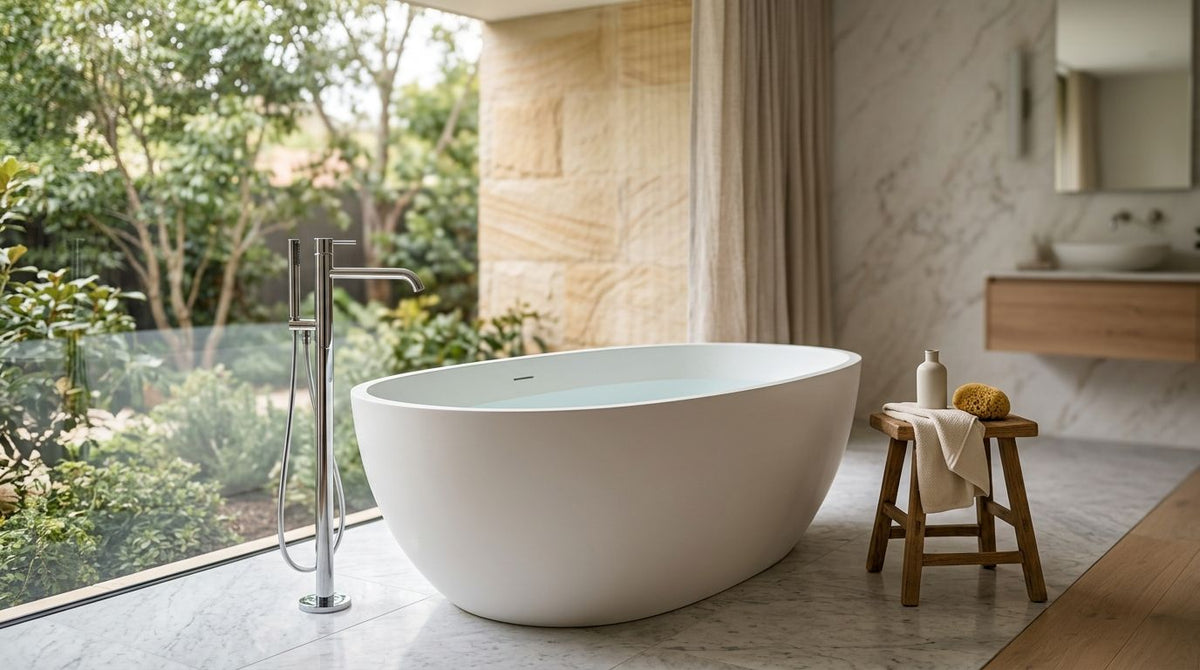
Best overall for a reclined soak: Eviva Bella 60-inch acrylic slipper freestanding bathtub. Best for bathing from either end: a double-ended freestanding bathtub. Best for a tub placed close to a wall: a back-to-wall freestanding bathtub. For most homeowners choosing a freestanding bathtub in 2026, start with the bathing position you want, then confirm the tub fits the room, delivery route and plumbing.
- Eviva Bella is the 60-inch acrylic slipper freestanding bathtub to consider for a reclined bathing position.
- Choose a double-ended freestanding bathtub if you want to bathe from either end; check the actual model's drain position.
- A back-to-wall freestanding bathtub suits a wall-side layout, but faucet access still needs planning.
- Before ordering in 2026, check the tub's full dimensions, delivery route, drain location and faucet requirements.
Why this matters
A freestanding tub has to work as a fixture, not just as the centerpiece of a bathroom photo. Its rim shape affects how you sit; its outer dimensions affect circulation around it; and its drain and faucet requirements affect installation. In a 2026 remodel, settling those questions before choosing a finish prevents a visually appealing tub from becoming a poor fit for the room.
The choices below compare one identified Eviva bathtub with two common tub configurations, not three tested models. Only the Eviva Bella has a named product page in this selection. Treat the other configurations as ways to narrow your search, then check the specifications of any individual tub you consider.
What makes the best freestanding bathtub?
- Room fit: Compare the tub's complete exterior dimensions with the finished floor plan. Account for doors, nearby fixtures and the space you need to get around it.
- Bathing posture: A raised slipper end suits someone who wants a defined backrest. A double-ended shape gives you a choice of sitting direction.
- Plumbing fit: Check the specified drain and overflow locations against your floor plumbing. Confirm which faucet installation the tub supports rather than choosing a faucet by appearance.
- Access for cleaning: Decide how you will reach the floor and wall beside the tub, particularly if the tub sits close to a wall.
- Material and care: Confirm the actual model's material and follow its care instructions. The material name alone does not establish how a particular tub will wear.
- Delivery route: Check whether the tub can pass through the doors, turns and stairs between delivery and the bathroom.
Best freestanding bathtubs at a glance
| Option | Best for | Standout feature | Key limitation |
|---|---|---|---|
| Eviva Bella 60-inch acrylic slipper bathtub | A defined reclined bathing position | Slipper shape and identified 60-inch length | The named product alone does not establish fit, drain position or soaking depth |
| Double-ended freestanding bathtub | Bathing from either end | Bathing positions at both ends | The chosen model's drain and backrest design need verification |
| Back-to-wall freestanding bathtub | A tub placed close to a wall | One side planned for a wall-side layout | Wall-side access and faucet placement need attention |
Eviva Bella is the best identified choice here for a homeowner seeking a 60-inch slipper-style freestanding bathtub. That is a design-and-fit verdict, not a claim that it outperforms every other tub. The right purchase still depends on the specifications of the tub and your bathroom.
Check installation fit before choosing a shape
Start with a drawing of the finished bathroom, including the vanity, toilet, shower and door swing. Mark where the tub would sit and where you would stand to enter it, clean around it and use the faucet. A tub that fits on the floor plan but blocks a cabinet or makes the faucet hard to reach does not fit the way you use the room.
Next, trace the route from the delivery entrance to the bathroom. Measure each doorway and turn, then compare the narrowest points with the chosen tub's documented dimensions. Do this before planning around the tub as the room's focal point; an elegant layout will not solve a delivery problem.
Finally, match the tub to the plumbing plan. Ask your installer to compare the manufacturer's drain, overflow and faucet instructions with the existing or proposed connections. Do not assume every freestanding faucet works with every freestanding tub. The faucet needs a suitable position and a usable reach into the bathing area.
If your 2026 remodel also includes a vanity, put both fixtures on the same plan. A named width is a starting point, not a measurement of open floor space: a 48-inch double-sink vanity and a 72-inch double-sink vanity create different layout demands, but neither tells you how much clearance remains without the room dimensions. Choose the tub and vanity as a pair of physical fixtures, not as separate shopping decisions.
1. Eviva Bella: best freestanding bathtub for a reclined soak
The Eviva Bella is identified as a 60-inch glossy white acrylic slipper freestanding bathtub. A slipper tub has a raised end intended to support a reclined bathing position. That makes this the clearest named starting point in this guide if you already know you want that shape and are assessing a 60-inch tub for your space.
Eviva Bella pros:
- Its 60-inch stated length gives you a specific dimension to check against your floor plan and delivery route.
- Its slipper shape gives you a clear bathing-position choice instead of a uniform-rim look.
- Its identified acrylic material lets you seek care instructions for the actual product rather than relying on a general material comparison.
Eviva Bella cons:
- A raised-end layout is less flexible if you want the same bathing position at either end.
- The product name does not tell you the internal bathing length, soaking depth, drain position or faucet requirements; verify those before ordering.
- A glossy white finish is a specific design choice, not a substitute for checking installation fit.
Best for: A homeowner who wants a slipper-shaped tub and can confirm that the Eviva Bella's full specifications work with the finished bathroom. Verdict: Buy only after confirming the installation details. If your priority is bathing from either end, choose a different configuration rather than asking the slipper shape to do a different job.
For 2026 planning, compare the tub's exterior length with the space available, then look beyond that one measurement. The interior contour determines where your body sits; the rim and faucet position determine how you enter and fill it. Ask for the product's installation information before placing the drain or finalizing floor work.
2. Double-ended tub: best for bathing from either end
A double-ended freestanding bathtub is a configuration, not a specific product recommendation. Its appeal is straightforward: both ends are intended to serve as bathing positions. If you and another household member prefer different sitting directions, or the room layout favors a faucet position away from the end where you recline, this is a useful shape to examine in 2026.
Do not infer the drain position from the phrase double-ended. Compare each model's diagram with your plumbing plan. Also check the interior profile: an exterior that looks balanced does not tell you how much space the bathing well gives you in either position.
Double-ended tub pros:
- It offers an alternative to the single raised backrest that defines a slipper tub.
- It lets you evaluate both sitting directions against the faucet and room layout.
- Its balanced shape can suit a tub positioned where more than one side is visible.
Double-ended tub cons:
- No particular double-ended model is specified here, so dimensions, material and drain placement remain unknown.
- Depending on where it sits, you still need to plan access around its sides for cleaning and installation.
- A shape that works from both ends does not automatically meet your preferred soaking depth or interior length.
Best for: A homeowner who values a choice of bathing direction more than a defined slipper backrest. Verdict: Hold until you have a specific model and its installation drawing. Compare that drawing with the Eviva Bella's specifications rather than treating shape alone as proof of a better fit.
3. Back-to-wall tub: best for a wall-side layout
A back-to-wall freestanding bathtub is designed as a floor-standing tub that can sit close to a wall. It is the configuration to explore when the room plan calls for a wall-side location rather than a tub displayed with space around every side. In 2026, that distinction matters more than the style label: it changes which edges you can reach and where the faucet can go.
Check the actual model's rear profile before assuming it will sit as drawn. You also need to know how the wall and floor junction will be finished, how the faucet will be serviced and how you will clean the accessible sides. Those are model- and installation-specific questions, not features established by the configuration name.
Back-to-wall tub pros:
- It gives you a defined layout option when the tub needs to sit beside a wall.
- It provides a useful alternative to centering a tub in the room.
- It makes wall-side placement an explicit part of the buying decision.
Back-to-wall tub cons:
- Access behind the tub is limited by the layout, so installation and cleaning plans need particular care.
- No specific model is identified here; dimensions, materials and plumbing details must be checked separately.
- It is not the right default if you want the tub to stand visibly clear of the walls.
Best for: A homeowner whose finished bathroom plan places the tub close to a wall. Verdict: Wait for a model-specific fit and plumbing check before committing. Do not choose this configuration solely because it appears to take up less space in a photograph.
How we ranked these freestanding bathtub choices
The order prioritizes an identified product with a stated length, material and shape, followed by configurations that solve distinct layout or bathing-position needs. It does not rank undocumented performance, soaking depth or durability. There is no basis here to claim that one unnamed configuration costs less, lasts longer or fits a particular bathroom better than another.
For your own shortlist, apply the criteria in the same order: finished-room fit, preferred bathing posture, plumbing compatibility, cleaning access, material care and delivery route. The Eviva Bella earns the first position because you can begin that check with a specific named bathtub; the other entries tell you when to seek a different shape. A final choice requires the individual product's measurements and installation instructions.
Which freestanding bathtub should you choose?
Choose the Eviva Bella as your default 2026 shortlist item if you want a 60-inch acrylic slipper tub and its full specifications match your room. Its raised-end shape is a reason to choose it, not a detail to overlook. If you want equal bathing options at both ends, start with a double-ended model instead. If your floor plan calls for the tub beside a wall, investigate a back-to-wall model.
Before you order any freestanding bathtub, compare its product drawing with a measured bathroom drawing. Confirm the delivery path, drain connection and faucet installation with the person doing the work. Those checks turn a preferred shape into a decision you can install.
FAQ
What is the best freestanding bathtub for a reclined soak in 2026?
The Eviva Bella is the identified 60-inch acrylic slipper tub to consider for a reclined soak in 2026. Confirm its interior dimensions and installation requirements before choosing it for your bathroom.
Is a slipper tub better than a double-ended freestanding bathtub?
A slipper tub is the better shape if you want a defined raised end for reclining; a double-ended tub is the better shape if you want to bathe from either end. Check the actual models' interior profiles before deciding.
What should I measure before buying a freestanding bathtub?
Measure the finished bathroom and the route the tub will take into it. Compare those measurements with the model's full exterior dimensions, then check nearby fixture access and plumbing placement.
Can a freestanding bathtub sit next to a wall?
Yes, but choose a model whose installation instructions support the intended wall-side layout. Plan for faucet positioning, installation access and cleaning around the tub.
Does a 60-inch bathtub fit every bathroom with 60 inches of floor space?
No. The Eviva Bella's stated 60-inch length alone does not establish room fit; you must account for its full dimensions, surrounding fixtures and the route into the bathroom.
Where should the drain go for a freestanding bathtub?
The drain must match the chosen bathtub's installation instructions and the bathroom plumbing plan. Do not assume its location from the tub's exterior shape; check the specific product drawing.
What material is the Eviva Bella freestanding bathtub?
The Eviva Bella is identified as an acrylic freestanding bathtub. Follow the care guidance for that specific product rather than assuming every acrylic tub has identical care requirements.
One last thing
A freestanding tub's most consequential measurement might be the narrowest turn on the way to the bathroom, not its position on the floor plan. Check that route before committing to a 2026 remodel layout; a tub you cannot bring into the room is not an installable choice.
Share:
Best alcove bathtubs in 2026
Best 24 inch bathroom vanities in 2026